
Exploring AI Paradigms: Model-Centric (Part #1)



In the next couple of posts, we’ll cover two primary paradigms in AI: model-centric and data-centric. Picture this: you’re working on a machine learning project. Where does your focus lie - on perfecting the model or curating the data?
If you’re intrigued, read on!
Model-Centric AI: Focus on Improving the Model
Model-centric AI focuses more on modeling, training, and tuning aspects. This paradigm involves working with a relatively clean and well-annotated dataset. Your mission is to develop the best model to solve a specific question from a given dataset.
ImageNet Case Study: How Model-Centric AI Helped Advance Computer Vision Algorithms
Let’s look at an example where model-centric AI was instrumental, especially in academic research, where the aim is often to push the boundaries of existing challenges and advance state-of-the-art performance.
The ImageNet challenge (ILSVRC) is a renowned image recognition contest with a dataset of 1.2 million images across 1000 classes. All are quality-controlled and human-annotated. The dataset includes a benchmark and explicit performance metrics, primarily established as a north-star problem for the computer vision research community. The main objective of the computer vision research community was to develop innovative algorithms to enhance object recognition accuracy on the ImageNet dataset.
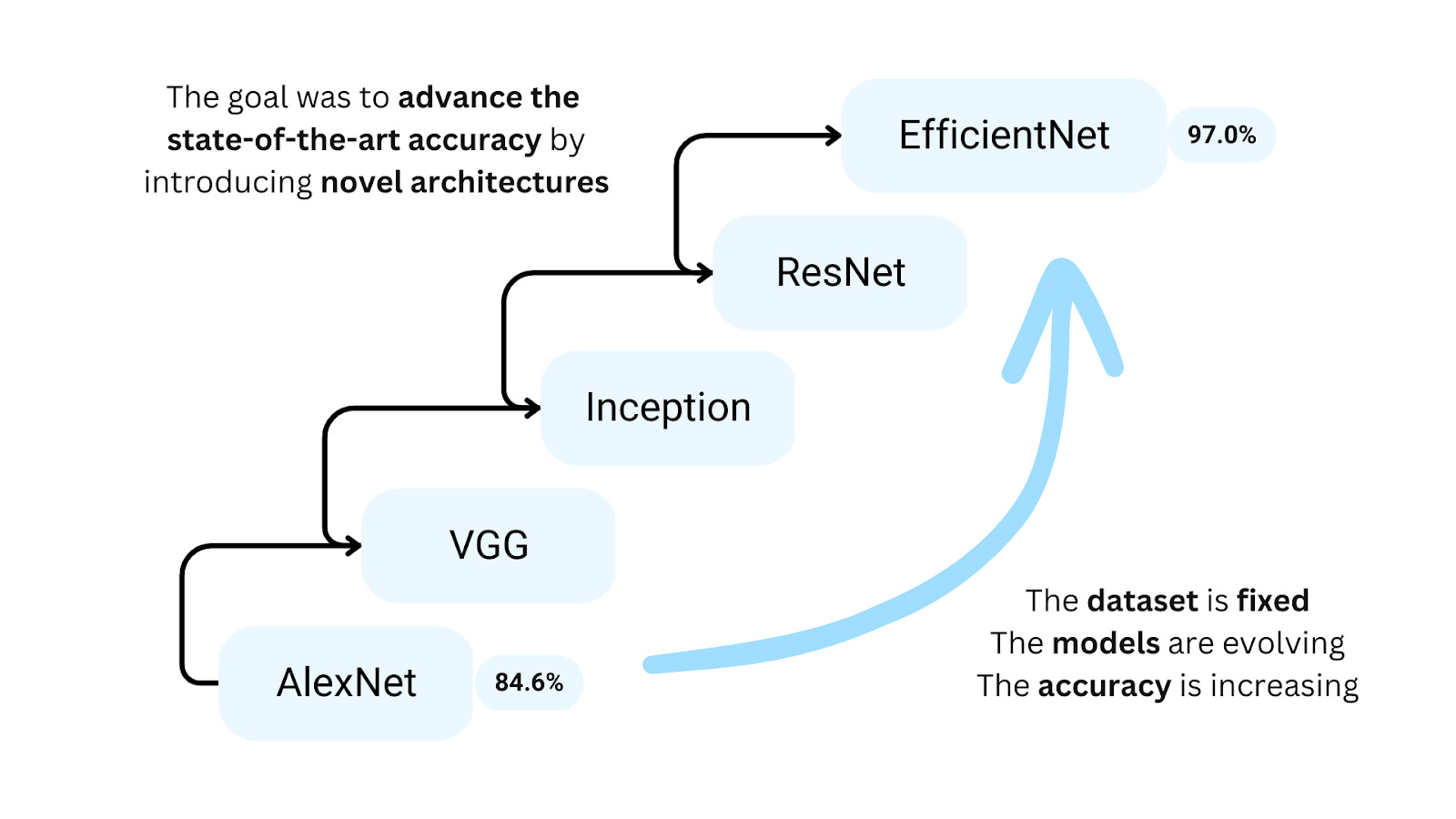
The researchers fixed the ImageNet dataset and focused on iterating the model architecture, training, evaluation, and hyperparameter tuning. As a result of this model-centric approach, state-of-the-art (SOTA) performance for image classification increased from 84.6% in 2012 to an impressive 97.0% in 2020. This journey led to the development of revolutionary computer vision algorithms such as AlexNet, Inception, ResNets, DenseNets, EfficientNets, and more!
The ImageNet challenge exemplifies the importance of model-centric AI, which is particularly beneficial in academic research, where advancing SOTA performance and exploring novel architectures and algorithms are top priorities.
In the next post, we'll explore the key strategies and methodologies that drive the model-centric approach in AI.
[Caption: The reported accuracy is the top-5 accuracy metric]
List of References: